
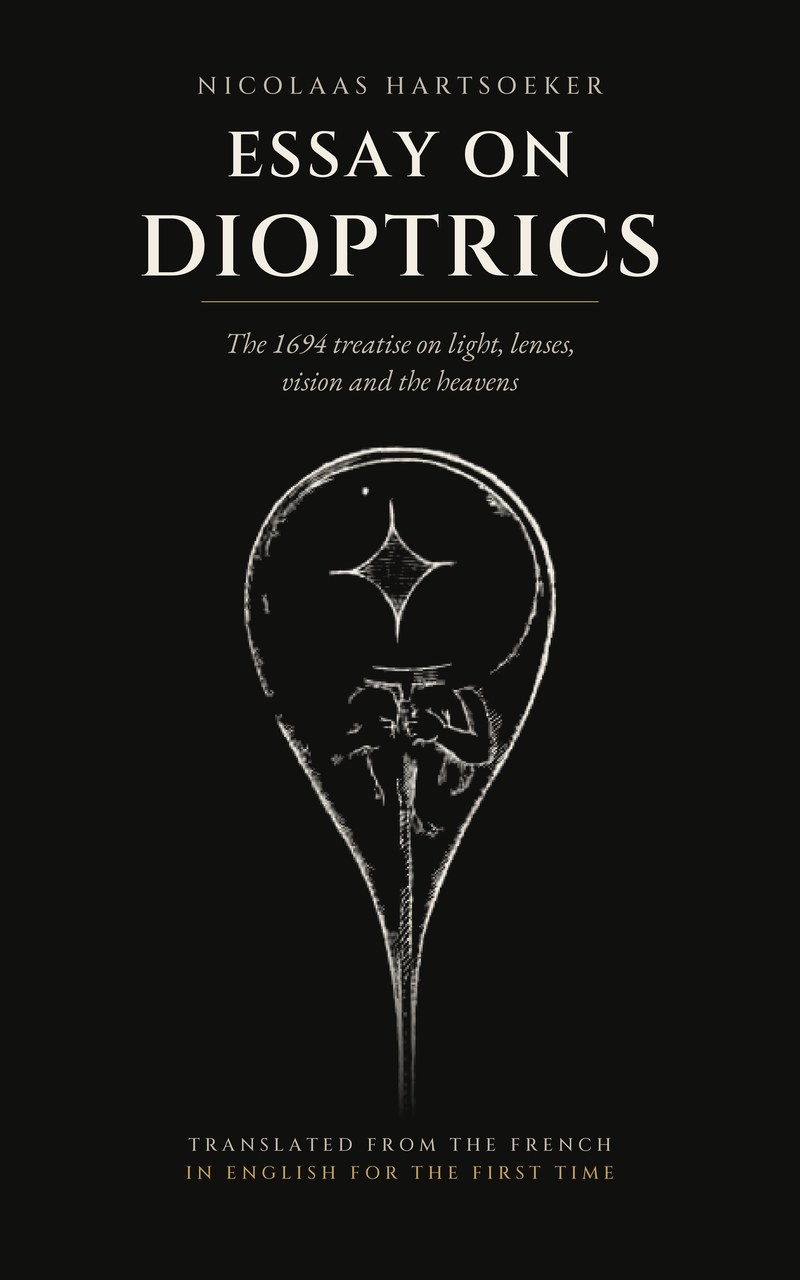
Nicolaas Hartsoeker · Paris, 1694
Essay on Dioptrics
The 1694 treatise on light, lenses, vision and the heavens — translated from the French, in English for the first time.
Reader's Edition · 6 × 9 in · published by Homunculus Cabinet
The book
In 1694 a Dutch lens-grinder living in Paris published a book explaining how light bends, how the eye sees, what the moon is made of, and what he had found swimming in a drop of seed. It has never appeared in English. This is that translation.
Nicolaas Hartsoeker ground his own glass, built his own instruments, and argued with Huygens and Leeuwenhoek as an equal. His Essay sets out an atomic theory of light; nineteen geometrical propositions that contain — written as proportions, because he had no algebra to write them with — the lensmaker's formula, the thick-lens formula and the nodal points of a lens; the eye as a darkened room; a map of the moon whose craters he takes for dug cities and whose bright rays he takes for roads; and the drawing on the front of this book, the most reproduced image in the history of embryology.
The translation is set against both surviving copies of the first edition. Every proposition in the geometrical chapter has been checked against modern optics, and several printer's errors that have stood since 1694 are identified. A reader's primer explains the optics from the beginning; nothing beyond arithmetic is assumed.
If one could see the little animal through the skin which hides it, we should see it perhaps as this figure represents it. Chapter X, Article XC
What is in it
- I–III. Light, and what he thinks it is made of — an atomic account, written against Descartes and against Huygens.
- IV. Refraction, with the table of refractions he computed degree by degree.
- V–VIII. Lenses: how to grind them, how to test them, what a combination of them does.
- IX. The geometry — nineteen propositions on where an image falls, how large it is, and what a second glass does to it.
- X. The eye, the telescope, the microscope, the moon, the comets, and the animalcules in the seed.
Two editions
They are two separate books, not two volumes of one. The translation in both is the same; what surrounds it is not.
The Reader's Edition
The complete translation, a primer that starts from nothing, the diagrams redrawn clean, and notes where the 1694 page is wrong. Meant to be read straight through.
The Scholar's Edition
The same translation with the original engravings printed facing the redrawings, the collation against both surviving copies of the first edition, the concordance of page numbers, and the full apparatus.
How it was made
From the page images of two copies of the 1694 printing: the Bibliothèque nationale de France copy and the Bibliothèque interuniversitaire de santé copy in Paris. Where the two differ, or where the printing is doubtful, the reading is recorded and the page cited.
The geometrical propositions were checked by computation, not by eye: each one was reconstructed and tested against modern optics before the English was settled. Where Hartsoeker's arithmetic fails, the note says so and says by how much.
Engravings reproduced from the copy held by the Bibliothèque interuniversitaire de santé, Paris — Medic@, under the Licence Ouverte (Etalab).